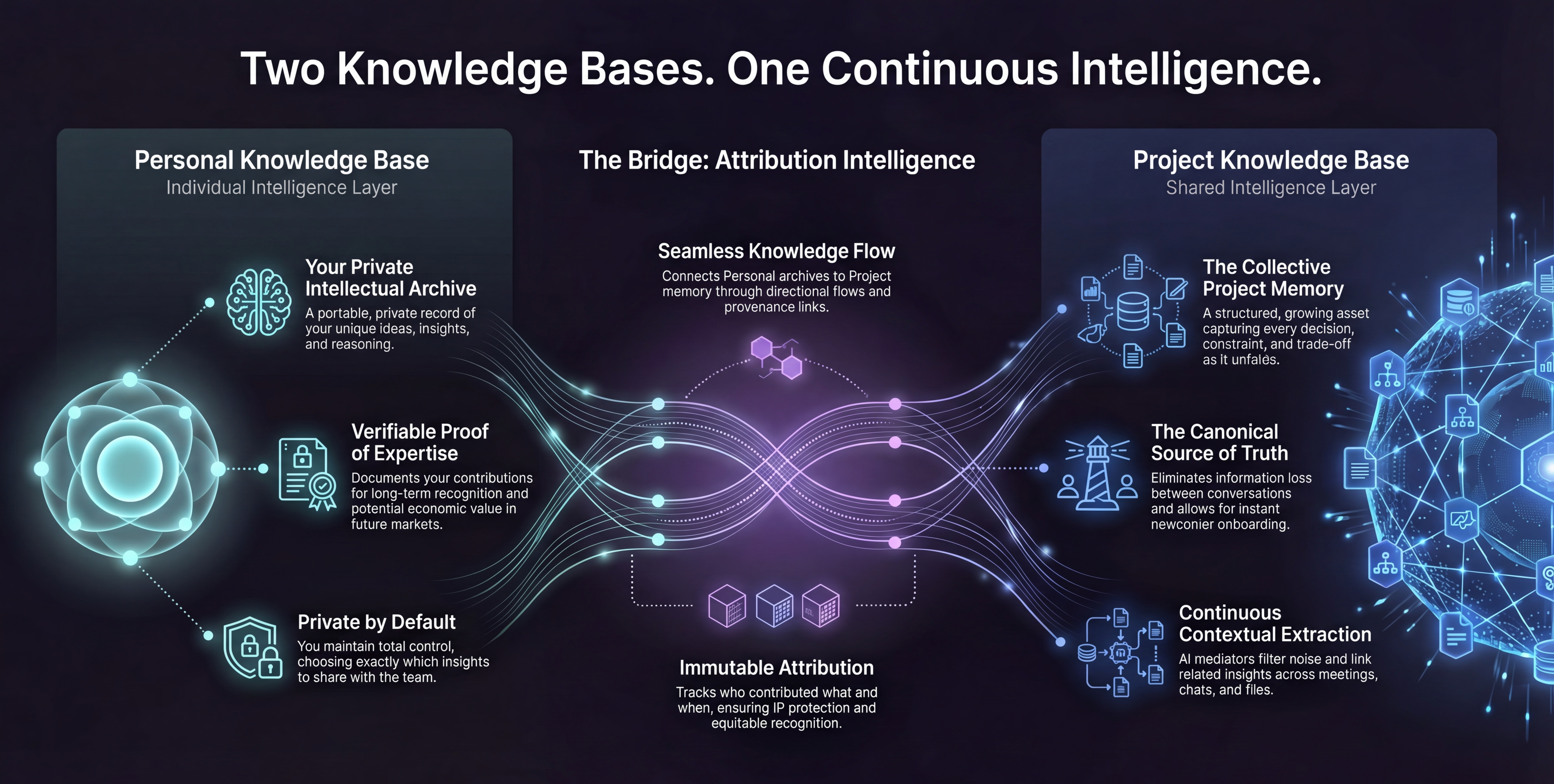
Today, a structural gap exists in how organizations work. Teams discuss, decide, and create through informal channels, meetings, chats, calls, shared documents, but the intellectual capital generated in these interactions evaporates almost as fast as it is created. Ideas get lost. Attribution becomes unclear. The transition from dialogue to deliverable requires manual reconstruction, every time.
This is not a productivity problem. It is an architectural one. The tools organizations rely on were built to store and retrieve what already exists, not to capture what is being created in real time. Search gives you results, not understanding. Documents preserve outputs, not the reasoning behind them. And when team members move on, they take years of accumulated context with them.
The consequences are tangible: decisions get revisited because no one remembers why they were made. New team members spend weeks reconstructing context that should already exist. Intellectual contributions go unrecognized because there is no systematic way to track who contributed what. Expertise that took years to develop leaves the organization the moment someone does.
The knowledge is there. It is being generated constantly, across every project and every team. The problem is that no existing tool is built to capture it, structure it, and make it persist.